Raw Denim Fading Explained — Mechanism, 5 Acceleration Methods & the Road to Vintage
Fade Theory · 2026-05-15 · ~2,100 words · ~7 min read
Contents (5)
- The Core-White Structure — Why Denim Fades At All
- Pattern-by-Pattern Formation Mechanics
- 5 Methods to Accelerate Fading
- Washing Frequency and Fade Character
- The Five-Year Fade Timeline
Raw denim fades are not random. The whiskers at your hip crease, the honeycombs behind your knee, the vertical streaks running down the thigh — each is the result of a specific physical mechanism playing out in the same fabric, every time. Understanding that mechanism lets you make intentional choices about how you wear, wash, and work your denim. This guide covers the core physics, pattern-by-pattern formation mechanics, five actionable acceleration methods, a washing frequency breakdown, and a five-year timeline.
The Core-White Structure — Why Denim Fades At All
Indigo does not penetrate cotton fiber. It bonds to the outer surface of each yarn, leaving the core white. This "core-white" structure — shin-shiro (芯白) in Japanese, visible if you snap a dyed yarn and examine the cross-section — is the fundamental reason denim fades the way it does.
Synthetic indigo was commercialized by BASF in 1897, but the dyeing behavior is identical to its natural predecessors: the dye sits on the surface, and the surface is what wears away. As friction, washing, and UV exposure progressively strip that outer layer, the white core becomes exposed.
The critical consequence is differential fading. High-friction zones lose their indigo faster; low-friction zones retain it longer. The visible contrast between these zones — deep blue holding against bright white — is what we call atari (当たり): the marks left by the relationship between cloth, body, and motion.
Pattern-by-Pattern Formation Mechanics
Whiskers — The Radial Lines at the Hip Crease
Whiskers (hige, 鬚) form where the fabric creases radially at the crotch and upper thigh when you sit. The ridges of those creases take continuous friction; the valleys are shielded. Ridge indigo wears away to white; valley indigo stays deep blue. The result is a radiating fan of bright lines against a dark field.
The shape of your whiskers tends to be highly personal. Body proportions, sitting posture, and fit all influence the angle, depth, and spread of the crease. A tighter fit tends to produce sharper, more pronounced whiskers because the crease folds more acutely; a relaxed fit tends toward softer, more diffuse lines. Two wearers rarely develop identical whisker patterns — it is among the more biometric fade markers in the garment.
Honeycombs — The Grid Behind the Knee
Honeycombs (hachi no su, 蜂の巣) are caused by repetitive horizontal creases that form as the knee flexes. The grid pattern — resembling a honeycomb in raking light — is created by alternating ridges (friction zone, fades white) and valleys (protected zone, stays dark).
What distinguishes honeycomb formation from other fades is its dependence on sustained crease memory. Wash frequently in the early stages, and the fabric resets before the pattern locks in. Wearers who cycle daily, hike regularly, or do frequent squatting work develop honeycombs faster and more pronounced — the range of motion is wide and the repetitions accumulate quickly.
Vertical Fading (Tate-Ochi) — The Warp-and-Weft Contrast
Vertical fading (tate-ochi, 縦落ち) is most strongly associated with selvedge denim. Warp threads are indigo-dyed; weft threads are undyed white. As the exposed warp wears away on high-contact surfaces, the white weft beneath becomes visible, creating fine vertical streaks across the fabric face.
This effect is amplified by irregular warp tension — a characteristic of shuttle-loom construction. Uneven thread density creates variation in how much dyed warp sits at the surface, which is why shuttle-loom selvedge tends to produce more pronounced tate-ochi than fabric woven on modern projectile or rapier looms.
Moonlight (Gekkō) — The Seat Bloom
Moonlight (gekkō, 月光) is the gradual, even brightening that develops across the seat and upper back of the thigh. Unlike whiskers and honeycombs, it is not driven by sharply creased fabric — it results from sustained, uniform contact pressure from sitting. The fade spreads softly across the surface like diffused light, without hard edges, hence the name.
Among long-term raw denim wearers, moonlight is considered one of the hardest fades to engineer deliberately, and therefore one of the most valued. It emerges from accumulated hours in chairs — nothing more, nothing less.
5 Methods to Accelerate Fading
1. Delay the First Wash — Minimum 3 Months
The no-wash period establishes the crease memory that all subsequent fades are built on. Whisker and honeycomb patterns need time to physically lock into the fabric — a process measured in months, not weeks. Three months minimum before the first wash is the common benchmark among enthusiasts. What matters as much as calendar time is wear density: six hours of daily wear over three months produces more deeply set creases than casual weekend wear over six months.
2. Brush and Air-Dry After Each Wear
A firm garment brush run lightly over the fabric after wearing removes surface fibers, loosened dye particles, and particulate contamination before they accumulate. It also improves air circulation, which reduces salt and oil buildup between washes. Hang inside-out in indirect airflow to dry. This combination meaningfully extends the interval between necessary washes without sacrificing hygiene.
3. Maximize Knee Range of Motion
Honeycombs specifically require knee flexion to form. Any activity that takes the knee through its full range — cycling, hiking, stair climbing, squatting — accelerates honeycomb development. Wearers who combine desk work (sustained sitting for whisker formation) with an active commute (cycling for honeycomb formation) tend to develop comprehensive, compound fade patterns faster than wearers who do only one or the other.
4. Water-Only or Salt-Water Washes
Surfactant-based detergents strip indigo efficiently and evenly, which accelerates overall fading but reduces contrast between atari zones and undisturbed fabric. Wearers optimizing for high-contrast, sharp-pattern development tend to wash with cold water only, or with a small amount of dissolved salt. The scientific mechanism of salt fixation on indigo is not definitively established, but eliminating surfactants demonstrably reduces dye loss per wash cycle — and that is the functional point.
5. Start With High-Density Indigo Fabric
The visual drama of raw denim fades scales with the depth of the starting dye. A heavily dyed fabric — one that has undergone significantly more dye passes to achieve near-black indigo saturation — produces a more dramatic contrast between worn and unworn zones as fading progresses over years. The ratio of original darkness to eventual core-white exposure defines the ceiling of how visually striking the atari can become.

桃太郎ジーンズ 特濃 TOKUNO BLUE クラシックストレート 15.7oz ONE WASH
organweb
Momotaro's Tokuno Blue line uses significantly more dye passes than standard production to achieve near-black indigo saturation on 15.7oz fabric — providing the deep starting point that makes high-contrast atari development possible over years of wear.
Washing Frequency and Fade Character
Washing frequency affects both the speed and the character of fading — not just how fast color is lost, but what kind of contrast pattern develops.
| Frequency | Fade Speed | Pattern Sharpness | Primary Risk |
|---|---|---|---|
| Weekly+ | Fast | Low — creases reset constantly | Accelerated fiber wear |
| 1–2× per month | Moderate | Moderate | Good balance |
| Every 3–6 months | Slow | High — creases set deeply | Hygiene management |
| 6+ months between washes | Very slow | Very high | Fiber fatigue, hygiene |
The most common approach among dedicated wearers: minimize washes for the first three to six months to allow crease patterns to lock in, then shift to a monthly cadence once the main atari zones are established. Extended no-wash periods past six months carry genuine fiber fatigue risk — the goal is strategic timing, not indefinite avoidance.
The Five-Year Fade Timeline
Month 1: The Impression Period
No visible fading yet. The fabric is at peak indigo saturation and full rigidity. The critical work is happening invisibly: crease patterns are beginning to form at the hip crease, behind the knee, and at every point where the body meets the fabric under sustained pressure. The folds that establish now define the atari architecture for the next five years.
Month 4: Whiskers Start to Lock In
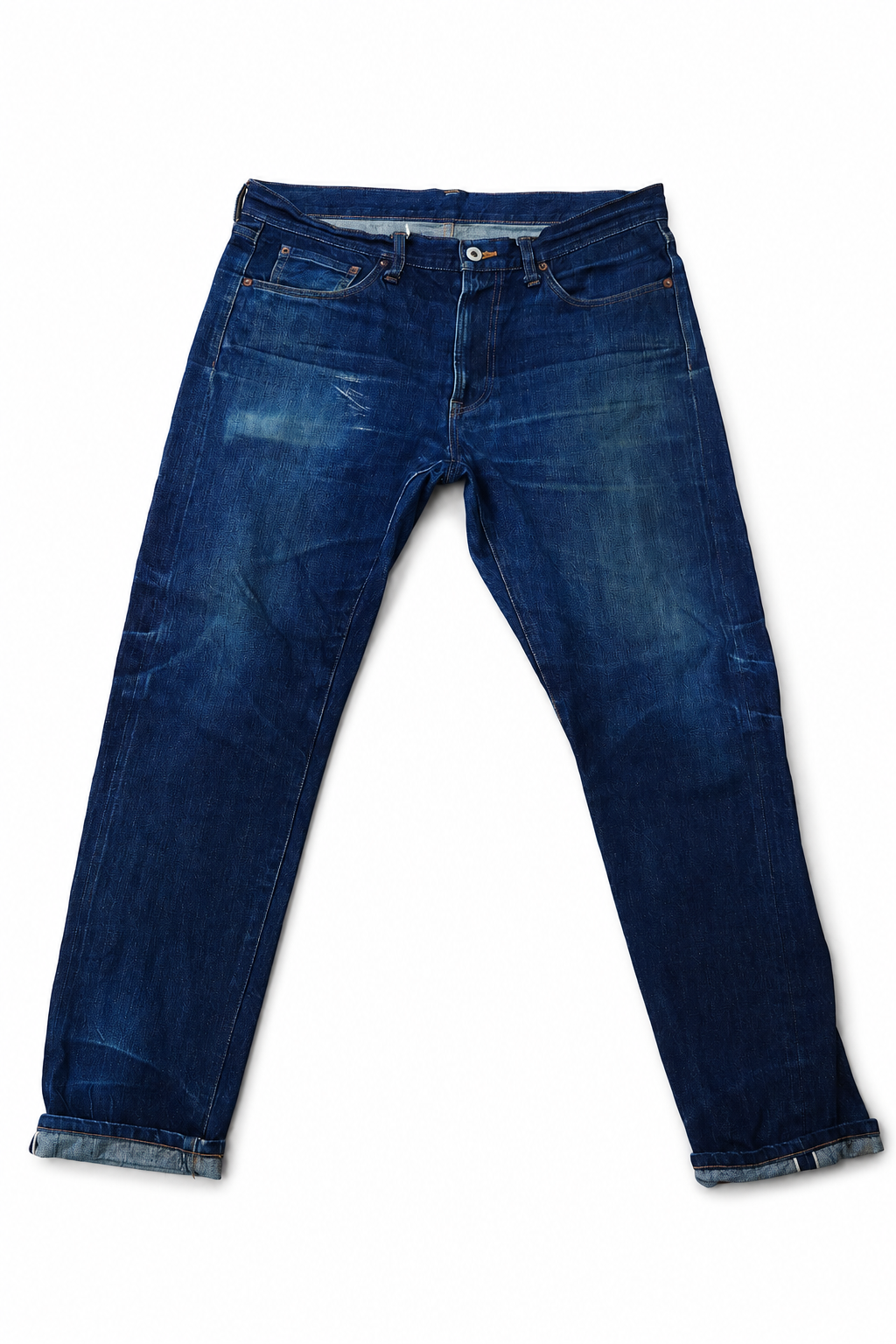
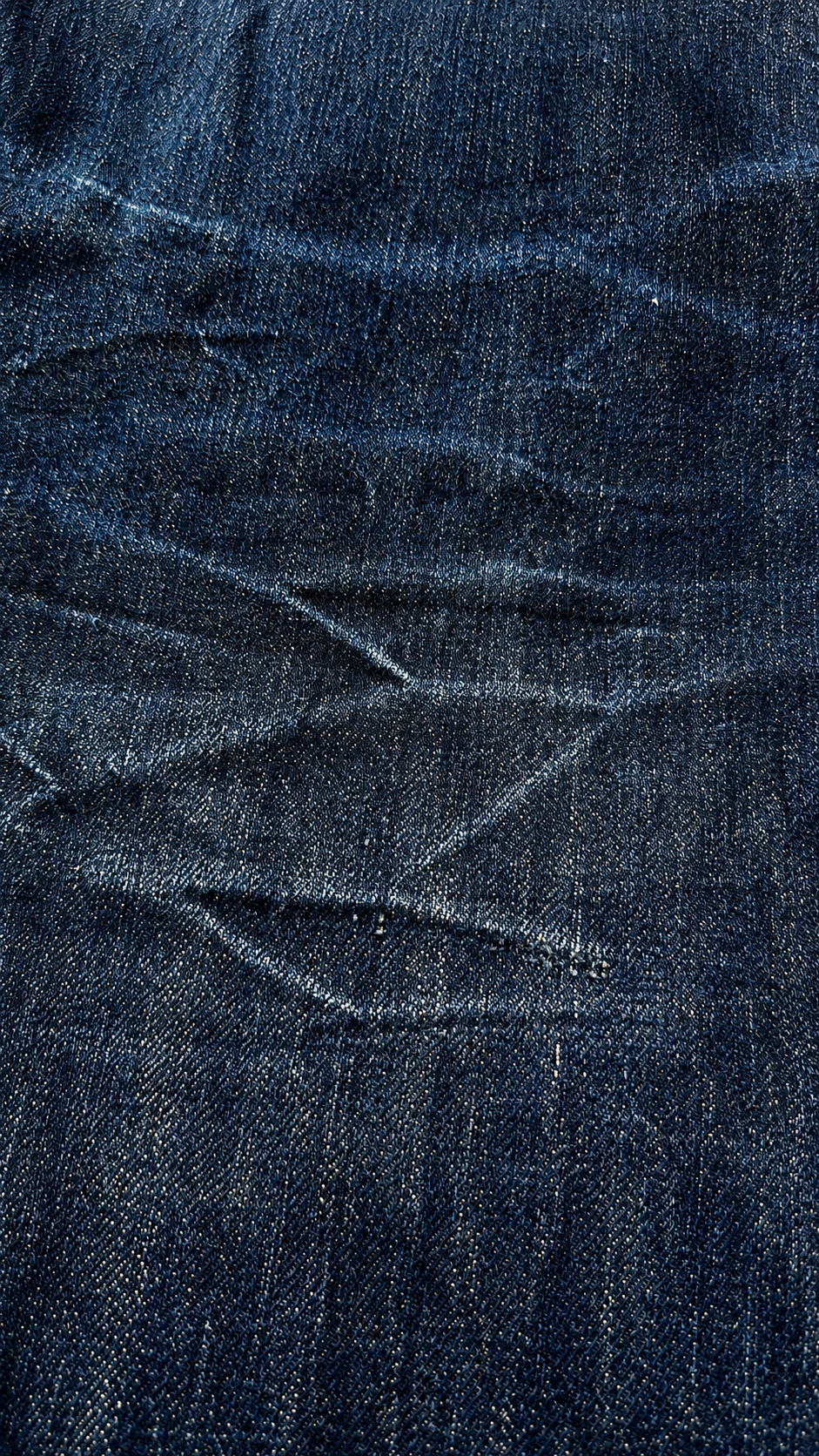
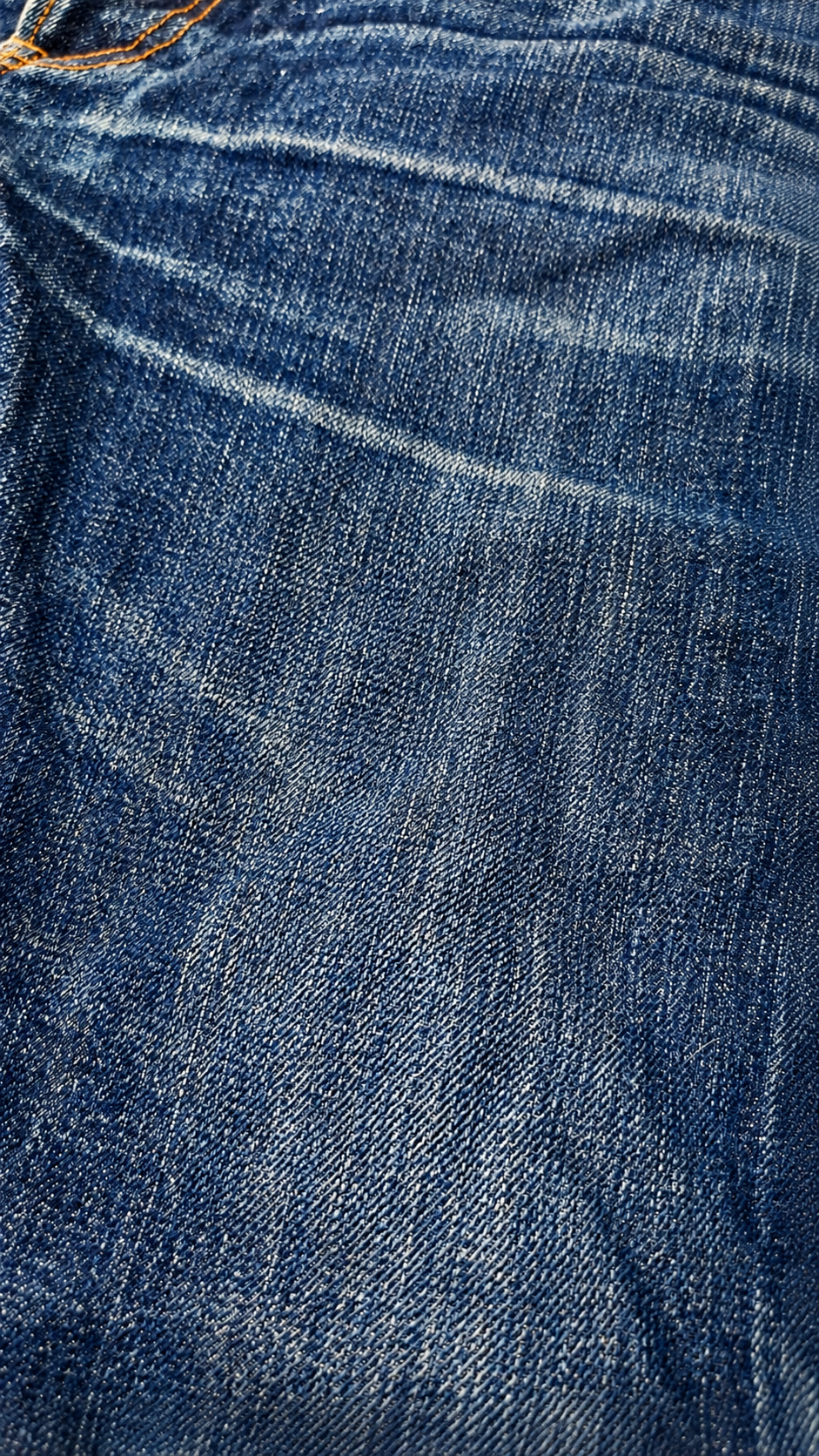
Depending on wear density, around month 4 whiskers begin to register as faint white lines and the fabric starts to show texture. Knee-back honeycombs are still just creases without dimensional depth. Indigo remains deep — significant contrast development is still ahead.
Month 6: Patterns Emerge
Whiskers become clearly legible as bright radiating lines against the indigo field. Early honeycomb patterns are visible in raking light behind the knee. Tate-ochi begins to register on selvedge fabrics. The seat shows the first faint traces of moonlight development. At this stage, the jeans have begun to look genuinely personal — the record of a specific body in motion.
Year 1: Full Establishment
All main atari zones are locked. High-friction areas show exposed core-white; low-friction areas remain deep blue. Contrast is typically at its most visually striking at this stage — the midpoint between the dark starting condition and eventual overall lightening. One-year fades are often considered the most photogenic by enthusiasts, and the most immediately legible as a record of wear.
Year 5+: The Vintage Register
Overall indigo has lightened noticeably. Atari no longer stands out as sharply against the background — instead, the whole garment has shifted toward a unified mid-blue field with softened traces of the original pattern. The fabric has lost its original rigidity and conformed to the body. Repairs — reinforced knees, pocket edge stitching, worn bar-tacks — have accumulated their own visual history.
This is the personal vintage register: not the collectible deadstock that commands high prices at auction, but a garment that is irreplaceable precisely because no one else could have faded it the same way. The fade is a record of years of body, motion, and choice — stored in cotton and indigo.
There is no single correct approach to fading raw denim. Understanding the physics of indigo, the mechanics of each atari pattern, and the effect of washing cadence gives you the tools to make deliberate decisions. The specific combination of those decisions — shaped by your body, your work, your daily movement — is what produces a fade that is genuinely yours.
Sources & References
- Japanese Textile Science Association, indigo pigment surface adsorption and colorfastness research reports
- Consumer Science Society of Japan, friction-induced dye degradation and textile durability literature
- International textile trade press archives, denim fabric construction and dyeing documentation
- Fashion and Clothing Culture Society annual reports, denim fabric fading characteristics
Share this article
Related Articles
- Fade TheoryDenim Whiskers Formation Explained: 3 Factors That Determine Pattern, Angle & IntensityThe radial lines etched by hip flexion: whiskers. Their count, density, and angle are shaped not jus…
- Fade TheoryDenim Honeycomb Fade Explained: 3-Stage Formation Process & 4 Tips to Deepen the Crease PatternHoneycombs aren't formed in a single moment. They emerge through three stages — dynamic creases, sem…
- Fade TheoryDenim Atari Fade Patterns Explained: Tate-Ochi, Yoko-Ochi, Dan-Ochi & Marble — 4 Types ComparedJapanese denim culture identifies four distinct lineages of fade pattern. Each emerges from a differ…
Related Articles
Articles in the same category: